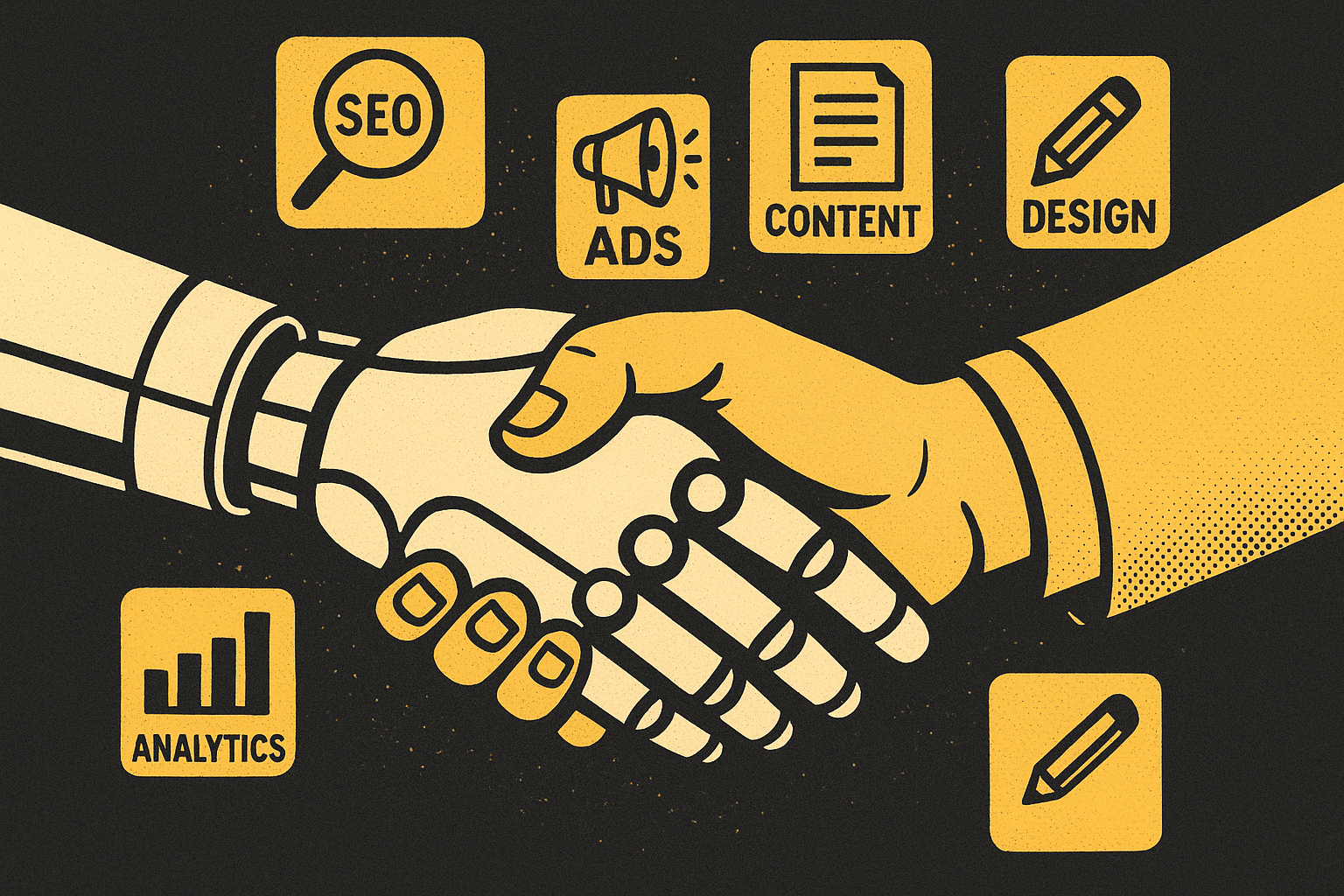
I posted about this on LinkedIn recently. The post hit 32,700+ impressions, reached over 24,000 members, and generated 222 reactions, 44 comments, 22 reposts, and 94 saves. It brought 82 profile viewers and 61 new followers from a single post. Clearly, the topic struck a nerve.
So I wanted to go deeper. Because the conversation in the comments revealed something interesting: people agreed with the headline but disagreed on what it actually means.
What the Conversation Revealed
The comments split into several distinct perspectives—and the disagreements were more illuminating than the agreements.
George Fischer, a healthcare CMO who's generated $2.9B in revenue on $430M in ad spend, pushed back on the generalist optimism:
It's extremely hard to be knowledgeable enough in all those channels to do them well even with AI. AI is leverage on your skills—it doesn't magically make you good at social or content or ads or SEO. — George Fischer, Chief Marketing Officer for Healthcare Brands
He's right. And that's exactly the point. AI doesn't create expertise. It amplifies what's already there.
Sven Montanus took the idea further, arguing we need a new role entirely:
The role we need isn't just the generalist coming back. It's a new kind of role. Someone who thinks about marketing as AI by design from the start. Less marketing generalist, more marketing engineer. — Sven Montanus, Managing Partner at andweekly
Mário Mendonça nailed the semantic distinction that matters:
The “generalist” isn't coming back as someone who knows a little about everything, but as someone who knows how to integrate everything. What died wasn't specialization; it was fragmentation without orchestration. — Mário Mendonça, Marketing Manager
Meanwhile, Kerry Beckford connected it to the systems thinking that underpins the shift: “AI feels like it's rewarding marketers who understand systems across the funnel, not just individual channels.” And Katia L. zeroed in on what most people underestimate: “The years of pattern recognition, refinement, and learning turned into something usable. That doesn't happen overnight or with a few trendy prompts.”
Mario Schaefer offered a grounding reality check: “If you take a look at most SMBs, the marketing generalist has always been the champion.” Which is true—and why AI's impact is most transformative at the SMB level where these generalists were already carrying the load with fewer resources.
Christian Collison captured a sentiment many marketing leaders share: “It’s great to be back to vision and strategy, rather than vision, strategy and endless management of team members and their niche characters to ensure those elements are delivered on.” A new, direct line of execution means less overhead and fewer handoffs—the bottleneck was never the thinking, it was the coordination.
Adam Taylor drew the critical line between AI-generated output and genuine expertise: “Building the marketing frameworks aligned to your own knowledge, experience and how you interact with your specific client base to deliver true value is not a generic, one-size-fits-all from ChatGPT. It’s a concise structured formula built through considerable learning and research.”
And when Violet Engberts asked for practical advice on building the library behind the system, the answer revealed the real depth of the shift: start by categorizing your previous campaigns and annotating them with results. Turn those annotations into reusable context for AI tools. Build templates and strategies from real data, not theory. It’s a slow process—but it’s also the moat. Anyone can prompt ChatGPT. Not everyone has a decade of structured marketing intelligence to feed into it.
The thread revealed a consensus: the generalist is back, but with a higher bar. It's not about knowing a little of everything. It's about understanding how everything connects—and having the systems to act on it.
Some read it as "AI will replace specialists." Others as "now anyone can do marketing." Both are wrong. And the reality matters—especially if you're a healthcare organization figuring out how to structure your marketing in 2026.
The Specialization Era: How We Got Here
Between roughly 2014 and 2023, marketing fractured into increasingly narrow disciplines. A mid-size organization might employ or outsource to:
- An SEO specialist optimizing for rankings
- A PPC manager running Google and Meta ads
- A content writer producing blog posts and social copy
- An email marketing specialist managing sequences and segmentation
- A web developer handling landing pages and conversion optimization
- A designer creating visuals across every channel
- An analytics person interpreting dashboards
Each role became more technical, more tooling-dependent, more siloed. The logic made sense: marketing channels were complex enough that doing any one of them well required deep expertise.
The problem wasn't specialization itself. The problem was that nobody was looking at how the pieces fit together.
Your SEO agency reports rankings. Your ads agency reports clicks. Your content team reports posts. Each report looks fine. But nobody reports where they overlap, where they contradict each other, or where money falls between the cracks.
This isn't theoretical. In one healthcare practice I worked with, Google Ads was paying $4,200 per month for keywords the SEO strategy already ranked #1 for. That's $50,000 a year, invisible—because the two agencies never compared notes.
Specialization created expertise within channels. It also created gaps between them.
What AI Actually Changed
When people hear "AI in marketing," they picture one of two extremes:
- The replacement fantasy: Press a button, AI does your marketing. No humans needed.
- The gimmick dismissal: AI just generates mediocre content. It's a toy, not a tool.
Both miss the point. Here's what AI actually did:
It dramatically reduced the execution cost of tasks that used to require specialist hours.
Writing a landing page used to take a copywriter 4-6 hours. Building a responsive email template required a developer. Creating a competitive keyword analysis meant days in SEMrush or Ahrefs. Designing a social media graphic needed a designer with brand guidelines open on their second monitor.
AI didn't eliminate the need for these skills. It compressed the execution time for someone who already understands what good looks like.
AI doesn't replace experience. It multiplies it. A generalist with 10 years of pattern recognition across channels can now deliver what used to require a team—because AI handles the production while the human handles the judgment.
A junior with no experience gets AI-generated content that looks professional but lacks the strategic foundation to actually perform. The output is polished. The thinking is shallow.
The "Library" Behind the System
This is the part most people skip over when they talk about AI-enabled marketing.
I spent years building a library. Brand guidelines. Campaign frameworks. Conversion templates. Patient journey maps. Content strategies that actually worked. Audit checklists refined across hundreds of projects.
Then I spent days—not hours, days—turning all of that into a structured system that AI can actually use. Not generic prompts copied from Twitter. A knowledge base built from real results and real client work.
That setup? Most people won't do it. It's not glamorous. It's not instant. It's organizing a decade of experience into something usable and repeatable.
But once it's built, one person can deliver what used to need a strategist, a designer, a developer, and a copywriter. Same quality. Same strategic depth. Faster execution.
Is it cheaper than hiring all of them separately? Yes. Is it cheap? No. Because you're paying for the library behind the system—not the system itself.
This is what separates the "AI-enabled generalist" from "someone who uses ChatGPT." The former has the strategic depth that makes the output work. The latter has speed without direction.
What the Data Says About the Market Shift
The timing isn't coincidental. The market conditions that made hyper-specialization necessary have fundamentally changed.
Companies are spending more on marketing tools than ever, yet 44% of those tools sit unused (Gartner). Healthcare organizations saw patient acquisition costs jump from roughly $200 to $312 in three years (First Page Sage 2026). And Google's AI Overviews now appear on 43% of healthcare queries—the highest of any industry—dropping organic click-through rates by 61% even for #1-ranked pages (BrightEdge, Dataslayer 2025).
In this environment, having six separate specialists each optimizing their own channel isn't just expensive. It's structurally incapable of catching the cross-channel problems that matter most.
| Challenge | Specialist Team | Deep Generalist |
|---|---|---|
| Google Ads bidding on keywords SEO already ranks for | Neither team sees it—each reports their own metrics | Caught immediately. One person sees both dashboards. |
| Landing page converting at 2% for 18 months | Traffic team says "we're sending traffic." CRO isn't anyone's job. | Flagged in context. Connection between traffic quality and conversion is obvious. |
| AI Overview eating organic traffic on key terms | SEO team reports rankings (still #1). Traffic drop not connected to AI. | Recognizes the structural shift. Adjusts strategy across SEO + content + paid. |
| Facebook CPL rising 20% YoY while patient value stays flat | Social team optimizes within Facebook. Doesn't question channel viability. | Reallocates budget to higher-performing channels based on cross-channel data. |
The pattern is consistent. The most expensive problems in marketing aren't within channels. They're between them. And only someone looking at the full picture catches them.
What This Means for Healthcare Organizations
Healthcare has specific conditions that make the generalist model particularly relevant:
1. Compliance limits experimentation
HIPAA restrictions mean you can't just test every tool and platform freely. Each new tool introduces compliance risk. A generalist who can accomplish more with fewer tools isn't just cheaper—they're safer.
2. The decision-maker isn't a marketer
The physician-owner or practice administrator evaluating marketing has limited time and limited marketing vocabulary. They don't want six agency reports. They want one person who can say: "Here's what's happening across your marketing, here's what it means, and here's what to do next."
3. Attribution is uniquely broken
88% of healthcare appointments are scheduled by phone. The entire digital journey disappears the moment someone dials the number. In this environment, optimizing any single channel in isolation is borderline meaningless. You need someone who can map the full patient journey from first search to booked appointment.
4. Small practices compete against large systems
This is what excites me most. A small practice with a smart marketing partner can now compete with hospital systems that have 20-person marketing teams. That wasn't possible two years ago. AI + cross-channel strategy + healthcare expertise levels the playing field in ways that benefit the organizations that need it most.
Deep Generalists vs. Deep Specialists: Both Survive
This isn't a "generalists win, specialists lose" argument. The market is bifurcating:
Deep generalists who built real systems—people with broad experience across channels who've organized that experience into repeatable frameworks, now amplified by AI—are more valuable than ever. They see patterns that specialists miss. They execute faster than teams. They cost a fraction of building a full department.
Deep specialists who are genuinely exceptional—the SEO person who understands AI Overviews at a technical level, the paid media buyer who can profitably scale a $500K/month budget, the conversion optimization expert who consistently turns 2% pages into 8%—will thrive. Demand for top-tier specialists isn't going anywhere.
The competent-but-not-exceptional specialist. The person who's "good at Google Ads" but doesn't have a unique edge. The content writer who produces solid-but-generic blog posts. The social media manager who follows best practices but doesn't create breakout engagement.
AI can replicate their output. It can't replicate exceptional judgment or exceptional creativity. It can't replicate the pattern recognition that comes from seeing 200 marketing audits across 15 specialties. It can't replicate genuine human connection in storytelling.
The bar just got higher for everyone. Which is—uncomfortably, honestly—a good thing.
The Fractional CMO Model and Why It Fits
This shift is part of why the fractional CMO model is growing. The math changed:
| Approach | Annual cost | Cross-channel visibility |
|---|---|---|
| Full-time CMO + specialist team (5-7 people) | $400K–$800K+ | Depends on team communication |
| 3-4 specialist agencies | $150K–$400K | Almost none. Each reports their own silo. |
| Fractional CMO (deep generalist) | $50K–$150K | Built into the model. One person sees everything. |
Companies with fractional CMOs average 29% revenue growth versus 19% without (CMOx industry data). The edge isn't magic. It's structural: one experienced person with cross-channel visibility catches the overlaps, gaps, and misalignments that fragmented teams miss.
Add AI to that equation and the efficiency gap widens further. The fractional CMO with a well-built AI system isn't working alone. They have a force multiplier that lets them operate at a depth and speed that justifies the model even for organizations that previously assumed they needed a full team.
What This Means for You
If you're running a healthcare organization and evaluating your marketing structure, three questions matter more than "should we hire more specialists?":
- Who is looking at how your channels work together? Not each one individually—together. If no one, that's where the most expensive problems hide.
- When was the last time someone revisited the full picture? If your marketing was set up before 2024, the rules changed. CPC is up 40-60%. AI Overviews eat 43% of healthcare searches. The same strategy costs more and delivers less than it did two years ago.
- Do the people managing your marketing understand the cross-channel landscape—or just their channel? Both matter. But without someone connecting them, you're optimizing pieces while the whole underperforms.
The era of the marketing generalist is back. Not because specialists don't matter—they do. But because the gap between channels is where the real money is. And for the first time, one person with the right experience and the right tools can actually close it.